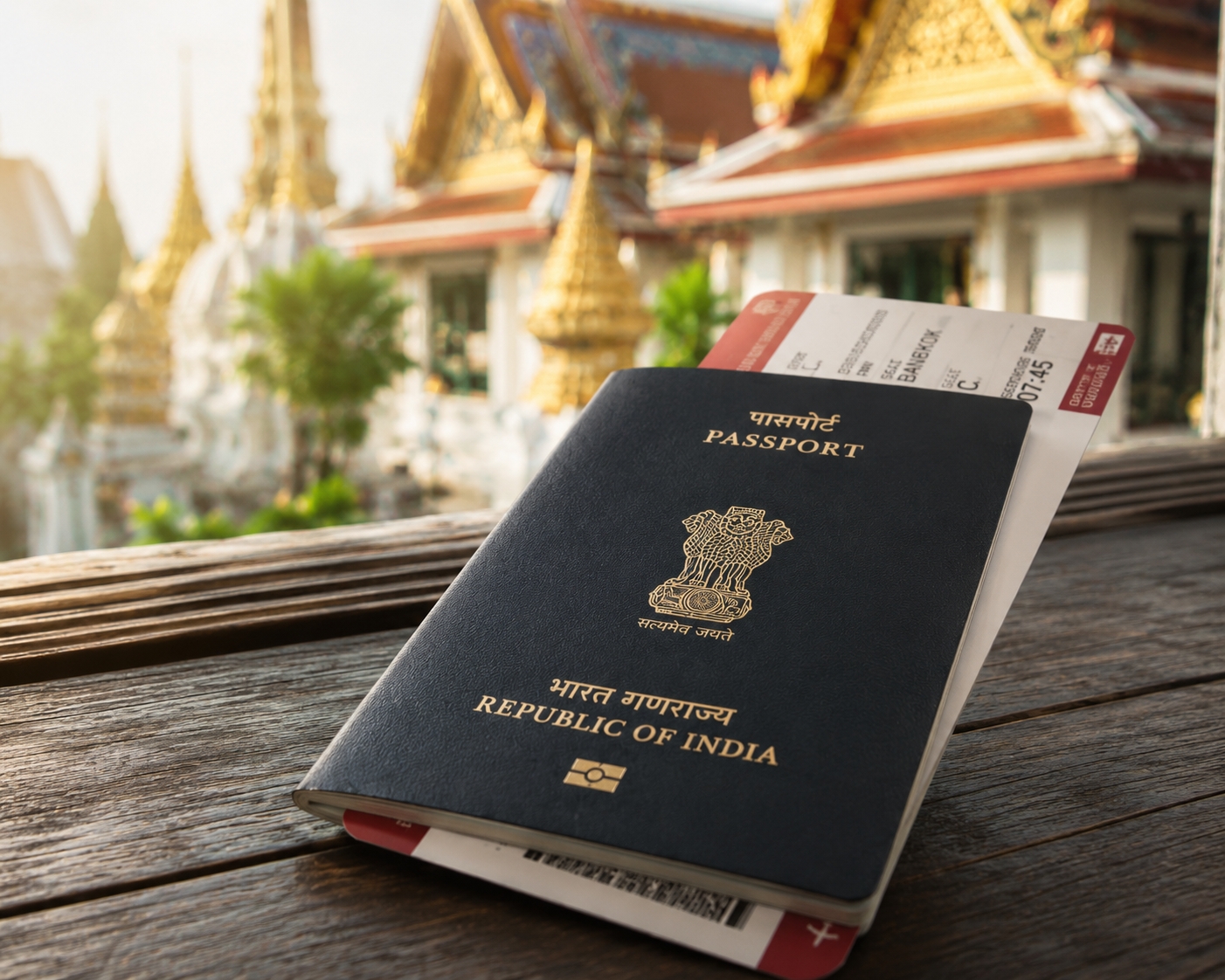
Visa and entry rules change — always verify current requirements. Visa, permit, and entry requirements are set by the relevant government and can change without much notice. The information here is a general starting point, not official guidance. Please confirm current requirements with the official embassy, consulate, or e-visa portal for your destination before you travel — we're also happy to help you check this as part of planning your trip with us.
If you've booked Thailand before, you probably remember it as the easy one. Land in Bangkok, walk through immigration with your passport, get a stamp, and head to the hotel. A lot of Indian travellers still plan it that way, and for a short holiday it mostly still works. But in 2026 a few details changed, and they're exactly the kind of details that matter when you've paid for flights and hotels months in advance.
This guide covers what Indian passport holders need to know right now: how long you can stay without a visa, the online arrival card, what officials may ask for at the airport, and what to do if your plans don't fit the standard rules. We've kept it practical and plain, and we've been careful to say where something is a reported rule rather than something you can treat as final, because entry rules are set by governments and they can change.
The headline change: 30 days, not 60
For a while, Indian tourists could enter Thailand without a visa and stay for up to 60 days. That has been reduced. Thailand has moved Indian citizens into a 30-day visa-exempt category for tourism, with the new rule reported to apply to entries from 15 September 2026. KPMG's global mobility alert on the change lists India among the countries placed in the 30-day tier, and the exemption is described as being for tourism purposes only.
What does that mean in practice? For a typical holiday of a week or ten days, almost nothing. A five-night Bangkok and Phuket trip fits comfortably inside 30 days. The change matters if you were planning something longer, such as a month-long stay, a stop-over combined with other countries, or an extended workation, and it matters if you've seen older blog posts or videos that still say 60 days. Some of those are still circulating, and they're now out of date.
What "tourism only" really means
The exemption is for tourism. It isn't permission to work, including remote work for an Indian employer in a way that Thai authorities might consider unauthorised, and it isn't a route to a long stay. Reports on the reasons for the tightening point to concern about visitors misusing the visa-free system. For an ordinary holidaymaker none of this is an issue, but it's worth knowing so you don't arrive with a plan that doesn't fit the rules.
If you'd like to stay longer than 30 days, reported rules allow one extension of 30 days at a local immigration office, with a fee reported at 1,900 baht. Treat that figure as something to confirm on arrival rather than something to plan around, because fees and procedures can change.
The Thailand Digital Arrival Card (TDAC)
The other thing every traveller should know is the Thailand Digital Arrival Card, or TDAC. It replaced the paper arrival card and is completed online. It collects the basics: your passport details, flight information, where you'll be staying, and the purpose of your visit. It's reported to be free, and to be submitted within 72 hours before you arrive.
Two practical tips. First, use only the official government TDAC site. Third-party sites that charge a fee for filling in a free form do exist, and you don't need them. Second, do it a day or two before you fly, not at the airport counter. Keep a screenshot or PDF of the confirmation on your phone, because airlines and immigration officers may ask to see it.
Your passport: the boring part that causes the most problems
Most visa problems have nothing to do with visa policy. They're passport problems. For Thailand, the generally advised rule is that your passport should be valid for at least six months from the date you enter, with enough blank pages for stamps. If yours expires within that window, renew it before you book, not after. Airlines can and do refuse boarding on a passport that doesn't meet the destination's rules, and that's a very expensive surprise to get at a check-in desk.
Also check that the passport isn't damaged: water damage, a torn page, a loose cover. Immigration officers can refuse a passport that looks tampered with, even if the damage is innocent.
What officials may ask for at the airport
You will usually be waved through, but it helps to have a few things on your phone and, if you like paper, in your bag:
- Your return or onward ticket. A one-way arrival with no onward flight is the most common reason a traveller gets questioned.
- A hotel booking or an address for at least the first nights.
- The TDAC confirmation.
- Evidence of funds. Thailand has long had a stated requirement for visitors to be able to show money for their stay. It's rarely checked on ordinary holiday arrivals, but officers have the power to ask, so keep some cash and a card available and know roughly how much you plan to spend.
None of this should stress you out. It's about being the kind of traveller whose story is easy to confirm in thirty seconds.
Fixing the "we want to stay longer" problem
If your plan genuinely doesn't fit the 30-day tourism exemption, because you want to stay longer, travel for another purpose, or combine Thailand with a long trip, then the right approach is to look at the proper visa categories before you go, not to hope for the best at the border. Thailand operates an official electronic visa portal, and the Royal Thai embassy and consulates handle applications from India. The category that matters for a long tourist stay is a tourist visa, and requirements such as financial proof and accommodation evidence are set by the Thai authorities.
Please don't overstay. Overstaying a permitted stay in Thailand can lead to fines, detention and being barred from re-entering, and it's far simpler to extend or leave on time than to resolve afterwards.
Booking implications: what to check before you pay
A few checks save a lot of grief:
- Count your days. If you've planned a long trip, count from your arrival date, not the date you booked. Thirty days from entry is thirty days from entry.
- Look at what the airline requires. Some airlines ask for proof of onward travel at check-in for Thailand-bound flights.
- Check your travel dates against the rule change. If you're travelling soon and relying on something you read earlier in the year, double-check. The rule applies to entries from the reported effective date, so anything older may have been written for the 60-day regime.
- Buy travel insurance. It's not a Thai entry requirement for tourists in the way a visa is, but it's sensible for any international trip, and medical costs abroad can be steep.
A simple countdown, so nothing gets missed
Here's the order we'd suggest working through, from the day you decide to go to the day you fly.
About two to three months before: check your passport's expiry date and blank pages. If it needs renewing, start now, because renewal times vary and you don't want to be waiting on paperwork with non-refundable flights booked.
About one to two months before: confirm the visa-exempt stay for your dates on an official source, count your trip days from your arrival date, and decide whether anything in your plan, such as a longer stay or a different purpose, needs a proper visa. This is also the time to book travel insurance.
About a week before: save digital and printed copies of your flight tickets, hotel confirmations and passport. Check whether your airline has any extra requirements for Thailand-bound passengers.
Two to three days before: complete the TDAC on the official site and save the confirmation. Don't leave it for the airport.
On the day: carry your passport, onward ticket, hotel details and TDAC confirmation within easy reach, not packed in a check-in bag.
If you're travelling with children or parents
Families sometimes assume that the rules are looser for kids or older relatives. They aren't. Every traveller, including infants, needs their own valid passport and, where required, their own TDAC entry. Check each person's passport expiry separately, because it's surprisingly common for one family member's passport to be the one that's about to lapse. If an elderly parent uses a mobility aid or needs assistance at the airport, tell the airline in advance so it's arranged before you arrive.
Quick answers to the questions we hear most
Do Indians need a visa for a one-week trip to Thailand? Based on the reported rules, a tourist stay of up to 30 days is visa-exempt, so a week-long holiday normally doesn't need one, but you do need the TDAC and a valid passport.
Is the 60-day rule gone? For entries from the reported effective date, yes. Older articles that say 60 days are out of date.
Can I work remotely from Thailand on the exemption? The exemption is for tourism, and we're not the right people to advise on work rules. Check the official position or speak to an immigration professional.
What if I want more than 30 days? Look at an extension at a local immigration office, or apply for the appropriate visa in advance. Don't overstay.
Common mistakes we see
The most common ones are small. Booking a flight on a passport that expires in four months. Filling the TDAC on a look-alike site and paying for it. Assuming 60 days because a friend did it last year. Forgetting that connecting through a third country may have its own transit rules. And leaving the return ticket until later, then being asked for it at the airport.
None of these are dramatic, and all of them are avoidable by treating the visa and entry checklist as a part of the trip planning, not something to do at the end.
A note on food, since it's on every vegetarian's mind
Visa questions are usually the first worry for Indian travellers heading to Thailand, and food is the second. If you eat strictly vegetarian or Jain, Thai cooking has hidden complications: fish sauce, shrimp paste and oyster sauce appear in dishes that look entirely vegetable-based. We've written a separate, detailed guide on that, vegetarian food in Thailand: a real guide, and it's worth a read before you go.
How we handle this for our travellers
For anyone booking one of our Thailand routes, we help with visa and entry checks as part of the package, and we confirm the current requirement for your specific dates before you commit, not after. Our Thailand Explorer is a six-day, five-night family route through Bangkok and Phuket, with return flights, hotels, daily breakfast, visa assistance and local transfers included, and every meal arranged 100% vegetarian and Jain-friendly across both cities. If you're younger and travelling on a tighter budget, our Thailand Hostel and Adventure trip is built around social hostel stays, island hopping and street food.
Whichever way you go, please check the official sources before you fly, because rules like these can change quickly. If you'd like us to confirm the current requirement for your dates, message us on WhatsApp or through the contact form and we'll look it up with you before you book anything.
Sources & credits