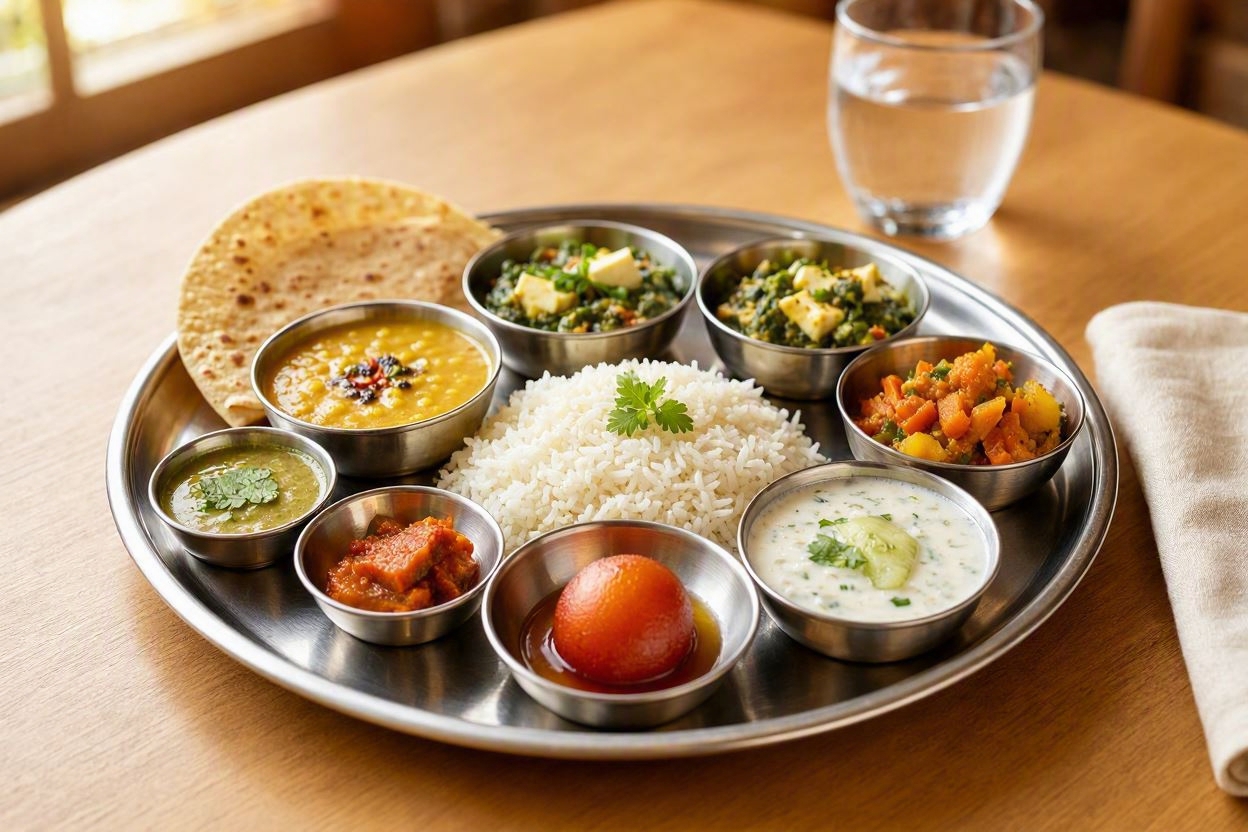
We guarantee what's in our control — sourcing and verification, not medical outcomes. We verify every hotel and restaurant partner for Veg & Jain compliance, and we brief every disclosed allergy or dietary need in advance — that part is genuinely in our hands. What we can't control is a condition we were never told about, or how a third-party kitchen we don't personally run handles cross-contamination. If you have any allergy or specific need, please tell us early so we can pass it on — and for anything involving a serious medical condition, please also check with your doctor.
If you eat strictly vegetarian or Jain, the first question on every trip abroad is the same: what will I actually eat? It's a fair question, and it deserves a more honest answer than "don't worry, there's always something." Sometimes there is. Sometimes "something" means plain rice and a side of boiled vegetables for five days, and that's not a holiday anyone has paid for.
This guide is meant to help you plan realistically. We'll start with what makes this harder than it looks, move through how to ask for what you need, then go region by region, and finish with how we handle it on our own routes. We'll be upfront about where it's easy and where it needs real planning, since that's what's useful.
Vegetarian is not the same as Jain, and neither is the same as "no meat"
This is the first thing to get straight, because the words mean different things in different countries. In India, "vegetarian" usually means no meat, fish or eggs. Abroad, it can mean "no visible meat", and a dish with vegetables cooked in chicken stock or topped with fish flakes may still be called vegetarian by the kitchen.
Jain food adds further restrictions. Many Jains avoid root vegetables such as onion, garlic, potato and carrot, and some avoid certain other ingredients as well, and practices vary between families and traditions. Many also observe rules about eating after sunset. Most kitchens abroad won't know any of this, so you'll have to explain it clearly, and often more than once.
Where non-vegetarian ingredients hide
The real problem isn't the obvious steak or seafood platter. It's the ingredients that don't show. Fish sauce and shrimp paste are used across Southeast Asia in curries, dips, soups and stir-fries. Oyster sauce is common in Chinese-style vegetable dishes. Stocks made from meat or fish can be the base of soups, noodles and even some rice dishes. Lard or animal fat may be used in frying. Gelatin appears in desserts and sweets, and some cheeses use animal rennet. Egg is often in noodles, batters and sauces.
There's also the matter of shared cooking surfaces, such as woks, grills and frying oil used for both vegetarian and non-vegetarian food. For strict vegetarians and Jains, that's often the line that matters most, and it's the hardest to verify at a street stall.
How to ask so you actually get understood
A few principles make a big difference. Be specific and simple: "no meat, no fish, no fish sauce, no egg" works better than "I'm vegetarian." Say what you'd like instead of only what you don't want. If you're Jain, explain no onion, no garlic and no root vegetables in plain terms. Show a written card in the local language if you can, because pronunciation differs and a card avoids confusion. Ask about the cooking, not just the ingredients: "is this cooked with the same oil as meat?" And accept that in some places the answer will be "we can't guarantee that," which is useful information.
In Thailand, the word to look for is "jay" food, a strict vegan-style Buddhist cooking tradition that excludes animal products and often some strong-smelling vegetables, and you'll see yellow flags with red lettering outside restaurants serving it. In Vietnam, look for "chay" restaurants, which serve vegetarian Buddhist food, and the phrase "ăn chay" means to eat vegetarian. These are real, helpful traditions, and they're often better for strict vegetarians than a general restaurant.
Region by region: what to expect
Singapore, Dubai and other hubs with large Indian communities. These are generally the easiest. Indian restaurants, including pure vegetarian and sometimes Jain-friendly ones, are well established, and hotels are used to dietary requests. Even so, ask in advance for Jain food. See our guides to vegetarian and Jain food in Dubai and dining in Hong Kong.
Thailand. Rewarding but needing care, because fish sauce is almost everywhere. Jay restaurants help, as do Indian restaurants in the major tourist areas. Read our detailed Thailand guide.
Vietnam. Vegetarian options exist, especially in Buddhist-style chay restaurants, but the default cooking leans heavily on fish sauce. Planning matters. We cover this in is Vietnam vegetarian and Jain friendly?.
Sri Lanka. Much of the cuisine is built on rice and vegetable curries, which suits vegetarians well, but check for fish-based ingredients and shared kitchens. Our guide: eating Jain and vegetarian in Sri Lanka.
Bali and Indonesia. Tofu and tempeh are staples, and tourist areas such as Ubud have many vegetarian cafés. The challenge is in local warungs, where shrimp paste and shared frying oil are common. Tourist areas are easier than remote ones.
Bhutan. Much of the traditional food is based on chillies and cheese, which can suit vegetarians, but meat features in many dishes and menus, and remote stops have fewer choices, so advance coordination with guides and camps matters.
Maldives. Resort kitchens are generally used to dietary requests, and the key is to tell the resort early so the kitchen can prepare.
New Zealand, Europe and similar destinations. Vegetarian options are increasingly common in cafés and restaurants of larger towns, but Jain food is rarely understood, and small towns may have limited choices.
Small things that make a big difference
Tell your hotel before you arrive, not at the breakfast buffet. Carry reliable backup snacks for long travel days, such as dry fruits, khakhra, bars and instant options. Pack a small stock of dry foods if you're heading to remote areas. Learn two or three key phrases. Find out whether your hotel has a kitchen where staff can prepare simple food on request. And save a few vegetarian restaurant options near each place you'll be staying, so you're not searching hungry at 9pm.
If you follow Jain timing rules, plan your day around them: check dinner timings in advance and ask the hotel about early meals.
On the flight itself
Food starts before you land. Many airlines offer special meals, including vegetarian and, on some carriers, Jain options, but they usually need to be requested in advance, often at least a day or two before departure, and availability varies by airline and route. Check your booking, make the request, and confirm it again at check-in. Carry a few snacks anyway, since a special meal can occasionally go missing, and connecting flights are where this tends to happen.
A realistic day of eating abroad
It helps to picture what a good day looks like. Breakfast at the hotel, where you've already asked for vegetarian or Jain options, so there's something beyond fruit and toast. A lunch you've researched, perhaps at a vegetarian or Indian restaurant near your sightseeing for the day. Snacks in your bag to bridge the gaps. And a dinner you've planned for, either at a trusted restaurant or at the hotel, with timing that suits you.
It doesn't need to be elaborate. What it needs is for you not to be solving the problem from scratch three times a day, hungry, in a language you don't speak. That's the whole point of planning.
A short phrase card to carry
Write or print, in the local language where you can, the following in simple form: "I do not eat meat, fish, seafood or egg. Please do not use fish sauce, oyster sauce, shrimp paste or meat stock. Please do not cook my food in the same oil as meat." If you're Jain, add: "I also do not eat onion, garlic or root vegetables." Ask your hotel or a local friend to help translate it for the places you're visiting, or show the translation on your phone. A card isn't a guarantee, but it dramatically reduces misunderstandings.
Travelling with children and older parents
Kids who are fussy eaters and parents with specific dietary habits both benefit from predictable meals. Pack a few familiar snacks, tell hotels about each person's needs, and don't assume that a long sightseeing day will leave time to hunt for a suitable restaurant. For older travellers, who may be more sensitive to unfamiliar food or may follow stricter rules, build in simpler meal options and avoid placing too much reliance on street food.
Street food: tempting, and not always suitable
Street food is part of the pleasure of many destinations, and vegetarian and Jain travellers can enjoy parts of it, but it's the hardest place to verify. Shared grills, shared oil, sauces made with fish or meat stock and unclear ingredients mean that the stall owner may honestly not know what's in a particular sauce. If your restriction is strict, stick to places you've researched and food you can see being prepared separately, or skip the stall and enjoy the atmosphere instead.
Questions worth asking any travel company
Before you book, ask how they confirm vegetarian and Jain arrangements, whether it's done in advance with each hotel and restaurant, and whether they can be specific about your route. Ask what happens if something goes wrong on the ground, and whether they'll be honest about legs that are harder. A confident but vague "everything's arranged" isn't as reassuring as a specific answer. Our own answer, for what it's worth, is that we brief each partner in advance, we'll tell you plainly where a route is harder, and we'd rather you know the limits before booking than after.
If you're travelling in a group
Mixed groups, where some people eat everything and others are strict, need a little extra thought. Agree in advance where you'll eat so the vegetarian or Jain travellers aren't always the ones compromising. Choose restaurants with real vegetarian menus rather than a single token dish, and make sure the person organising the trip knows the requirements early. It's much easier to handle at the planning stage than at a restaurant table with ten hungry people.
What we can and can't promise
We want to be honest about this. On our routes, we brief hotels and restaurants in advance and verify our partners for vegetarian and Jain compliance, and that part is in our hands. What we can't do is control a third-party kitchen we don't run, or a condition or allergy we weren't told about. If you have an allergy or a specific dietary need, please tell us early so we can plan around it.
On some legs of a trip, such as remote mountain routes, we'll tell you plainly if extra planning or backup food is needed, because we'd rather you know in advance than find out on arrival.
How we plan food into our trips
Our routes are designed with food in mind from the start. Vietnam Highlights covers Hanoi and Halong Bay with every hotel and restaurant pre-briefed for vegetarian and Jain meals. Sri Lanka Tea Country and Coast is arranged 100% vegetarian and Jain-friendly from Kandy's hills to the coast. And our Thailand Explorer has every meal arranged across Bangkok and Phuket.
If you have specific requirements, message us on WhatsApp or through the contact form, tell us what you eat and what you avoid, and we'll tell you honestly how it works on the route you're considering.
Sources & credits