Visa and entry rules change — always verify current requirements. Visa, permit, and entry requirements are set by the relevant government and can change without much notice. The information here is a general starting point, not official guidance. Please confirm current requirements with the official embassy, consulate, or e-visa portal for your destination before you travel — we're also happy to help you check this as part of planning your trip with us.
Not a substitute for a certified guide. Trail conditions, altitude, weather, and fitness needs can change quickly and vary person to person. This article shares general, publicly available guidance to help you prepare — it isn't a safety assessment for your specific trip. Please trek with a certified local guide, check current conditions before you go, and make your own judgment call about fitness and readiness.
Bhutan is one of the easiest international trips an Indian passport holder can plan on paper. There's no visa to apply for. But "no visa" doesn't mean "no paperwork," and the permit and fee system sitting underneath that simple headline is what catches people out when they leave planning too late.
This guide explains what Indian travellers need for Bhutan: the documents you can use, how permits work, what the Sustainable Development Fee is and who pays what, how to get there, and the practical points that decide whether your trip runs smoothly. We've said where details come from published guides and may change, because rules like these are set by Bhutan's authorities and can be updated without much notice. Our own routes come at the very end.
Do Indians need a visa for Bhutan?
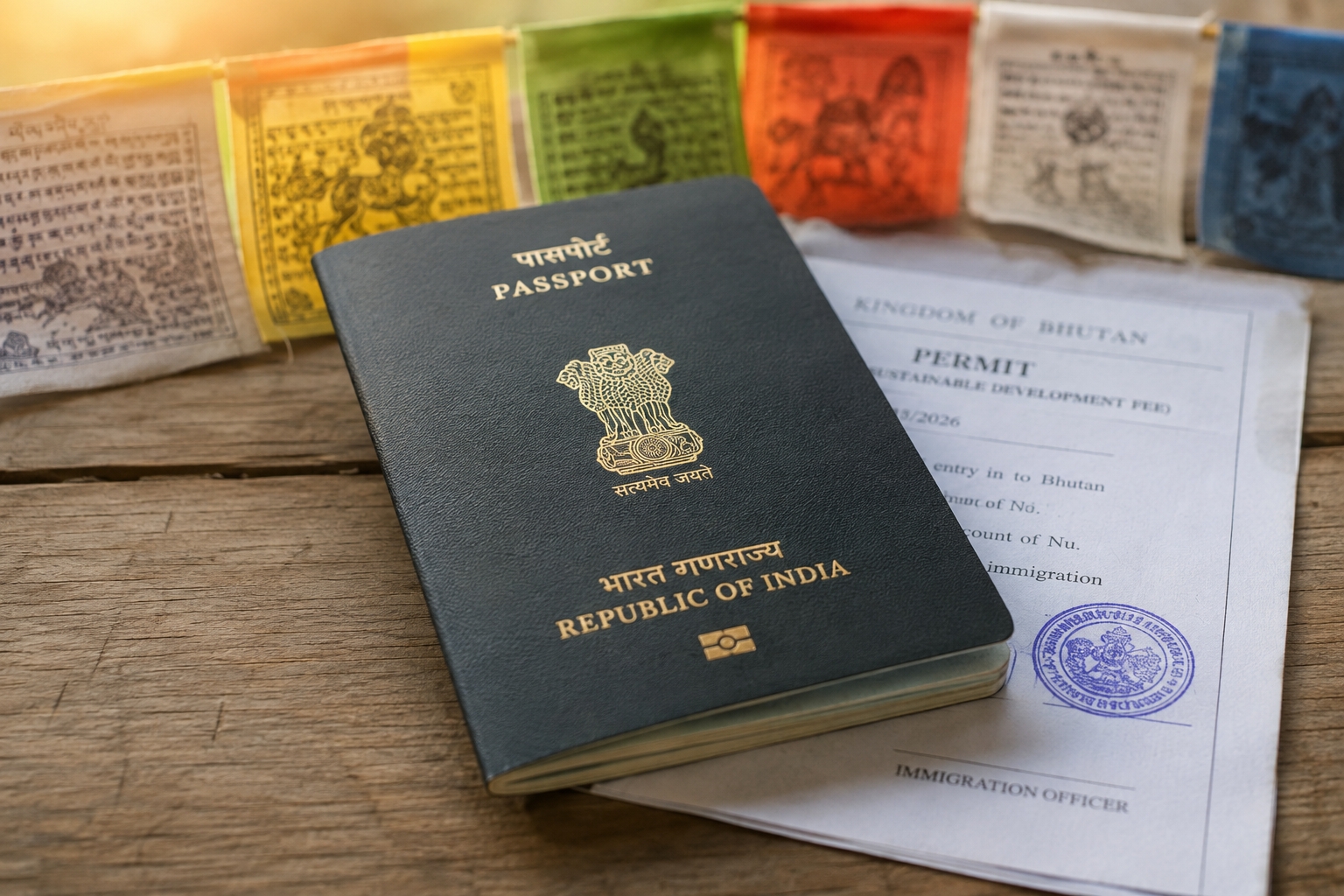
No. Indian nationals don't need a visa to visit Bhutan. This is one of the special arrangements between the two countries, and it makes Bhutan far simpler than most international destinations. You do, however, need an entry permit, which is a separate thing from a visa.
Which documents can you use?
Indian travellers can enter Bhutan with a valid Indian passport or a voter ID card issued by the Election Commission of India. If you use a passport, published guides say it should have at least six months of validity. Aadhaar cards are reportedly not accepted as a travel document for Bhutan, so don't plan on using one. You'll usually also need passport-size photographs for the permit application.
Children need valid ID too. Check what's required for minors, such as a passport or a school ID, with the official sources or your operator before travelling.
What's the permit?
Every visitor to Bhutan, including Indians, needs an entry permit. For Indian nationals this is a straightforward process, but it must be done before you cross, and the way you do it depends partly on how you enter. Published guides describe an online application through Bhutan's official tourism and immigration systems in advance, and also describe permits being issued at the border immigration office at the land crossing at Phuentsholing. Because those accounts differ in detail and procedures change, the safest approach is to check the current process on the official Bhutan immigration or tourism site, or to let a licensed operator handle it for you.
Travel beyond the main western valleys of Paro and Thimphu has historically needed an additional route permit. If your plan includes places further afield, such as central or eastern Bhutan, check this in advance. A good operator will arrange it and tell you what's needed.
The Sustainable Development Fee (SDF)
Bhutan charges visitors a daily fee, known as the Sustainable Development Fee, that supports the country's conservation, infrastructure and its "high value, low volume" approach to tourism. For Indian nationals, published guides report the SDF at 1,200 rupees per person per night, which is far lower than the fee charged to most other nationalities. Reports also describe a concession for children, with a reduced rate for children aged six to twelve and no fee for younger ones. Treat all of this as reported, and confirm the current amount and the rules for children before you book, because the fee structure has changed in the past and may again.
The SDF is separate from your hotel, food and transport costs. In a package it's normally built into the price, but if you're travelling independently you pay it yourself, so budget for it. When comparing prices between operators, check whether the SDF and permits are included, because it can make a "cheaper" quote look better than it is.
Can you travel without a tour operator?
Reportedly, yes: unlike most other nationalities, Indian travellers aren't required to book through a licensed Bhutanese operator. That freedom is real, and some travellers use it. But many still prefer an operator, especially for a first trip, for a few reasons: permits for routes beyond Paro and Thimphu, a licensed guide at monasteries and on mountain routes, reliable transport on winding roads, and help with food, since vegetarian and Jain meals take coordination outside the main towns.
How to get there
By air, Bhutan's international airport is at Paro, with flights operated by a small number of airlines from several Indian cities. Because there are few flights and the airport is in a mountain valley, seats can sell out early and schedules can be affected by weather, so book flights first, especially around festivals or Diwali.
By road, Phuentsholing, on the border with West Bengal, is the most commonly used crossing, and other land crossings in the south and east, such as Gelephu and Samdrup Jongkhar, are also used. Road journeys through the hills are long and winding, so allow more time than the distances suggest.
When to go
The most popular windows are spring, roughly March to May, and autumn, roughly September to November, when skies tend to be clearer and temperatures comfortable. Bhutan's religious festivals, called tsechus, are held at various monasteries at different times of year, and they're colourful, atmospheric events, though dates move each year, so check the calendar. Winter can be cold, with snow at higher altitudes but often clear skies, and the monsoon months can bring rain and landslides on roads.
If you're planning around a specific date, such as Diwali, lock in flights and permits early, because everything gets busy.
Altitude and fitness
Paro sits at around 2,200 metres, Thimphu a little higher, and the famous Tiger's Nest Monastery perches at roughly 3,100 metres above sea level, at the end of a steep hike that takes several hours there and back. Most healthy visitors manage it, but altitude affects people differently, and the climb is demanding. Take it slowly, drink water, rest when you need to, and treat it as optional if it doesn't feel right. If you have any heart, breathing or other health concern, please speak to your doctor before you go.
What to carry
A valid passport or voter ID and photographs. Printed and digital copies of your permit and bookings. Warm layers, because evenings are cool even in good seasons. Comfortable walking shoes with grip. Any regular medication. Some cash, since card acceptance can be patchy outside the main towns, and Indian rupees are widely used in Bhutan. And a basic first-aid kit and snacks for long road days.
Etiquette worth knowing
Bhutan takes its culture seriously. Dress modestly at monasteries and dzongs, and you may be asked to remove shoes and hats. Follow signs about photography inside temples, where it's often not allowed. Walk clockwise around religious structures, and don't touch prayer wheels or objects casually. Ask before photographing people. And treat the country's environmental rules, such as restrictions on littering, as part of the deal.
Food: vegetarian and Jain travellers
Traditional Bhutanese food leans on chillies and cheese, and a dish like ema datshi, chillies in cheese sauce, is vegetarian. But meat features in many dishes, and options can be limited at remote stops. Coordinating with guides and hotels in advance makes a big difference. Our guide to Jain and vegetarian food abroad covers how to ask for what you need.
A simple countdown
Two to three months before: check your passport's expiry or locate your voter ID, and decide on your dates. If you're travelling around Diwali or a festival, book flights now.
One to two months before: confirm the current permit process and fee amounts on an official source or through your operator, and make sure each traveller's ID is valid. Book travel insurance.
Two to three weeks before: apply for or confirm permits, and save digital and printed copies.
A few days before: check the weather and road conditions for your route, pack warm layers, and confirm your meals and hotel arrangements, including any vegetarian or Jain requirements.
On the day: keep ID, permit copies and tickets in your hand luggage.
Questions we're often asked
Do I need a visa if I fly into Paro? No visa, but you need the entry permit and valid ID.
Can I use Aadhaar? Reportedly not. Use a passport or voter ID.
Are Indian rupees accepted? They're widely used in Bhutan, but carry smaller notes and some cash, and check current guidance on denominations before you travel.
Is the SDF the same for everyone? No. Indian nationals pay a much lower rate than other nationalities, and children are reported to have concessions.
Is it safe to travel by road? Bhutan's roads are mountainous and winding, so journeys are slow, and weather can cause delays. A good driver and sensible timing make a big difference.
Can I extend my stay? Reports say extensions are possible through immigration offices in Bhutan, but check the current process.
Why the system exists
It helps to understand why Bhutan has permits and a daily fee at all. The country has deliberately chosen a "high value, low volume" model, limiting the impact of tourism on its culture and environment, and the SDF contributes to conservation, infrastructure and services. As a visitor, you're a guest in that model. Many travellers find that it's part of what makes Bhutan feel calm, uncrowded and unlike anywhere else, and that the paperwork is a small price for that.
Travel insurance and health
Medical facilities in remote areas can be limited, and evacuation from mountain regions can be costly, so travel insurance that covers medical expenses is a sensible choice. Speak to your doctor about altitude, vaccinations and any condition you have, and carry a basic medical kit and any prescribed medication.
Keeping the itinerary realistic
A five-day trip covers Paro, Thimphu and Punakha well, but not much more. Long road days between valleys, a morning for the Tiger's Nest hike and time at monasteries fill the days more than the map suggests. Resist the urge to add another valley, because Bhutan rewards lingering, not rushing. If you have more time, a longer route or a rest day is a better use of it than extra stops.
Common mistakes
Relying on Aadhaar as ID. Letting passport validity slip under six months. Leaving flights until late. Assuming the SDF is included when comparing quotes. Underestimating travel times on mountain roads. And overpacking the itinerary: Bhutan rewards a slower pace.
How we handle Bhutan
We arrange the permits and fee requirements as part of our Bhutan packages, so it's one less thing for you to coordinate. Our Bhutan Monastery Trail is five days and four nights through Paro, Thimphu and Punakha, with a licensed local guide throughout, permits and visa assistance, hotel stays, daily meals and all transfers, including the Tiger's Nest hike. Our Bhutan Diwali Fixed Departure is a seven-day, six-night small-group trip capped at sixteen guests, with flights from major Indian cities, timed for Diwali. Meals on both are coordinated for 100% vegetarian and Jain-friendly options.
If you'd like us to confirm the current permit and fee requirements for your dates, message us on WhatsApp or through the contact form before you book anything.
Sources & credits